Prometheanism by Christopher John Müller
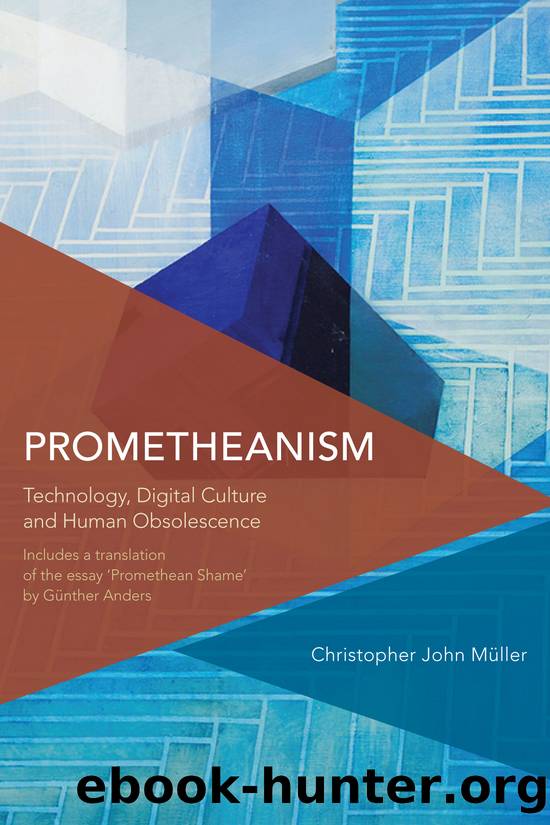
Author:Christopher John Müller
Language: eng
Format: epub
Publisher: National Book Network International
* The source text for the translation is: Günther Anders, âÃber Prometheische Schamâ, die Antiquiertheit des Menschen 1: Ãber die Seele im Zeitalter der zweiten industriellen Revolution (München: C.H. Beck, 2010), 21â95.
* natum esse: having been born â Trans.
* Molussia is a fictitious land invented by Anders (see the first endnote for further details). â Trans.
â Anders is here playing on the German âDaseinâ (existence), which literally means âto be hereâ. This has added (implied) significance because Dasein is the term Martin Heidegger deploys in Being and Time to suggest that humans exist in the sway of an experience of what it means to âbeâ â Trans.
* ÎÎ¼Î¿Î»Î¿Î³Î¿Ï Î¼ÎνÏÏ Î¶á¿Î½: to live as one with the gods â Trans.
* imitatio instrumentorum: imitation of instruments â Trans.
â nolens volens: like it or not â Trans.
* In German, the word fatal also carries the meaning âreally embarrassingâ â Trans.
* déjà vu [â¦] déjà lu: already seen [â¦] already read â Trans.
* summum bonum: the highest good â Trans.
* Rejectio fati: rejection of fate â Trans.
* This distinction is made by Immanuel Kant in the Critique of Pure Reason â Trans.
* As used by Anders, the German hybrid acts as an adjective that can denominate hubristic or hybrid qualities. I have used both words to underline this â Trans.
â Anders is playing on the words for measure and measuring (MaÃ, messen) that link the words âAnmessenâ and âAnmaÃungâ, which otherwise do not share a direct link in meaning â Trans.
* The followers of the early Christian theologian Marcion (AD 85â160) held the belief that because Jesus is the embodiment of love he could not possibly be the son of âthe cruel and wrathfulâ (i.e. Marcionist) god described in the Bible â Trans.
â By stealing fire, Prometheus hubristically refused to honour Zeus â Trans.
* Corinthians 15.55 â Trans.
* Aeternum [â¦] semperitum: âsomething eternalâ [â¦] âsomething that is alwaysâ. Anders is here playing on the nuances of these two Latin words meaning âalwaysâ. The former evokes the eternal realm of the âafterlifeâ whereas the latter has no such transcendental resonance â Trans.
â numerus clausus: âthe fixed number of placesâ on specific courses, which dictates competition for entry to university â Trans.
* The German is âüber-antwortetâ, again it possible to hear a resonance with Heideggerâs vocabulary. Being and Time presents human existence as unfolding in the space opened by the experience of âbeing delivered over and made answerableâ (Ãberantwortung) to the inescapable fact that one âis and has to beâ (see esp. the discussions of âthrownnessâ and âfacticityâ; §29ff.) â Trans.
* Moira: The Goddess of Fate; Tyche: The Goddess of Chance and Fortune â Trans.
â The text is here playing on divergent strands of meaning the word ârechnenâ can carry: (1) âto calculate, count and accountâ; (2) to âanticipateâ, to âweigh upâ, to âprocessâ and âwork something outâ; but also (3) to ârely onâ or to âcount onâ. Someone who is âunzurechnungsfähigâ is of âunsound mindâ and therefore declared ânot responsibleâ and ânot liableâ for his or her actions.
Download
This site does not store any files on its server. We only index and link to content provided by other sites. Please contact the content providers to delete copyright contents if any and email us, we'll remove relevant links or contents immediately.
| Anthropology | Archaeology |
| Philosophy | Politics & Government |
| Social Sciences | Sociology |
| Women's Studies |
Cecilia; Or, Memoirs of an Heiress — Volume 1 by Fanny Burney(32558)
The Great Music City by Andrea Baker(32018)
Cecilia; Or, Memoirs of an Heiress — Volume 2 by Fanny Burney(31956)
Cecilia; Or, Memoirs of an Heiress — Volume 3 by Fanny Burney(31941)
We're Going to Need More Wine by Gabrielle Union(19045)
All the Missing Girls by Megan Miranda(16023)
Pimp by Iceberg Slim(14506)
For the Love of Europe by Rick Steves(14121)
Bombshells: Glamour Girls of a Lifetime by Sullivan Steve(14073)
Talking to Strangers by Malcolm Gladwell(13370)
Norse Mythology by Gaiman Neil(13363)
Fifty Shades Freed by E L James(13239)
Mindhunter: Inside the FBI's Elite Serial Crime Unit by John E. Douglas & Mark Olshaker(9339)
Crazy Rich Asians by Kevin Kwan(9290)
The Lost Art of Listening by Michael P. Nichols(7506)
Enlightenment Now: The Case for Reason, Science, Humanism, and Progress by Steven Pinker(7311)
The Four Agreements by Don Miguel Ruiz(6763)
Bad Blood by John Carreyrou(6621)
Weapons of Math Destruction by Cathy O'Neil(6279)
